

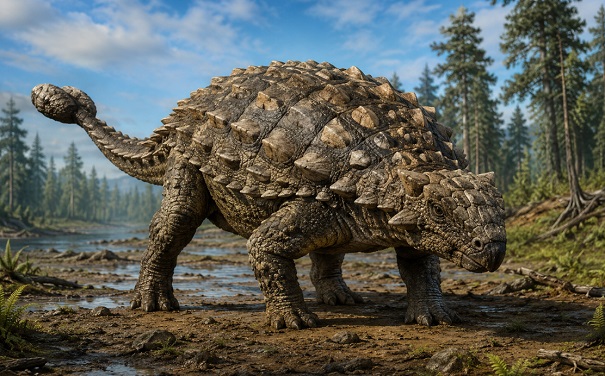
Euoplocephalus
Euoplocephalus / Armored dinosaur with clubbed tail for defense.
Euoplocephalus was one of the most heavily armored dinosaurs of the Late Cretaceous Period, famous for its tank-like body, protective bony plates, and powerful clubbed tail used for defense. This remarkable herbivore was built to survive in a world filled with large predators.
- What did Euoplocephalus eat?
- How did Euoplocephalus use its clubbed tail for defense?
- Where did Euoplocephalus live during the Cretaceous Period?
Below you’ll find clear answers to all of these—plus habitat, fossil discoveries, physical traits, defensive adaptations, behavior, and fascinating facts.
Ankylosauridae
Euoplocephalus was a large armored herbivorous dinosaur known for its bony body armor and heavy tail club.
Quick Facts
- Type: Armored dinosaur
- Diet: Herbivorous, mainly feeding on low-growing plants
- Habitat: Forests, floodplains, river valleys, and coastal plains
- Period: Late Cretaceous, around 76 to 67 million years ago
- Length: About 20 feet long
- Weight: Around 2 to 3 tons
- Conservation status: Extinct
Overview
Euoplocephalus was one of the best-known armored dinosaurs in North America. Its name means “well-armored head,” which perfectly describes its heavily protected skull and body. Unlike fast-running dinosaurs that escaped danger with speed, Euoplocephalus relied on armor, strength, and a powerful tail club to protect itself.
This dinosaur belonged to the ankylosaur family, a group of plant-eating dinosaurs famous for their protective body armor. Euoplocephalus looked almost like a prehistoric tank. Its broad body was covered with bony plates, while its tail ended in a large club that could have delivered serious blows to predators.
Physical Characteristics
Euoplocephalus had a wide, low body supported by four strong legs. Its build was not designed for speed but for stability and protection.
- Its body was covered in bony armor plates called osteoderms.
- The skull was broad, low, and heavily reinforced.
- Its legs were short and powerful, helping support its massive body.
- The tail ended in a large bony club used for defense.
- Even parts of the eyelids may have had protective armor.
Its armored body helped protect vital organs from predator attacks. The low body shape also made it difficult for large carnivores to flip it over and reach its softer underside.
Habitat and Distribution
Euoplocephalus fossils have been found mainly in western North America, especially in Alberta, Canada. During the Late Cretaceous Period, this region was very different from today. It had warm climates, river systems, forests, wetlands, and coastal plains.
These environments supported many types of plants, making them suitable for large herbivorous dinosaurs. Euoplocephalus likely moved through vegetation-rich areas where it could feed on low plants and remain close to cover.
Diet and Feeding Habits
Euoplocephalus was an herbivore, meaning it ate plants. Because its head was low to the ground, it likely fed on low-growing vegetation.
- Ferns
- Cycads
- Soft shrubs
- Low leafy plants
- Possibly young flowering plants
Its beak-like mouth helped clip vegetation, while its small teeth processed plant material. Euoplocephalus probably did not chew as efficiently as some other plant-eating dinosaurs, so it may have relied on a large digestive system to break down tough plants.
Clubbed Tail Defense
The most famous feature of Euoplocephalus was its clubbed tail. This tail was not just for display; it was likely an important defensive weapon.
The tail club was made of fused bones and could be swung from side to side. If a predator such as Albertosaurus attacked, Euoplocephalus may have used its tail to strike the predator’s legs. A strong hit could have caused pain, injury, or even broken bones.
- The tail club acted like a natural weapon.
- It may have discouraged predators from attacking.
- It could have been used in defense against large carnivores.
- It may also have been used in competition with other Euoplocephalus individuals.
Armor and Protection
Euoplocephalus had one of the most impressive armor systems of any dinosaur. Its body armor consisted of osteoderms, which were bony plates embedded in the skin.
These plates covered the back, sides, neck, and head. Some were flat, while others formed knobs or spikes. This armor created a strong shield against bites and claw attacks.
The skull was especially well protected. The dinosaur’s head had thick bone and armored surfaces that made it difficult for predators to injure it from the front or above.
Behavior and Lifestyle
Euoplocephalus was probably a slow-moving but confident herbivore. Instead of running from danger, it likely depended on its armor and tail club.
It may have spent much of the day feeding, resting, and moving through forested or floodplain habitats. Because it was so well protected, adult Euoplocephalus individuals may have had fewer natural enemies than smaller or less armored herbivores.
Scientists are not completely sure whether Euoplocephalus lived alone or in groups. Some armored dinosaurs may have been solitary, while others may have gathered in areas with good food sources.
Predators and Survival
Euoplocephalus lived alongside large meat-eating dinosaurs. One possible predator was Albertosaurus, a relative of Tyrannosaurus rex. Attacking a healthy adult Euoplocephalus would have been risky.
Its armor protected it from bites, while its tail club gave it an active way to fight back. Predators may have preferred young, injured, or sick individuals rather than fully grown adults.
Fossil Discoveries
Euoplocephalus is one of the better-known ankylosaurs because many fossils have been discovered. Fossil remains include skulls, armor plates, limb bones, and partial skeletons.
These discoveries have helped scientists understand how armored dinosaurs were built and how their defensive features worked. Fossils from Alberta, Canada, are especially important for studying this species.
Scientific Importance
Euoplocephalus is important because it shows how herbivorous dinosaurs evolved powerful defenses. It was not fast or aggressive in the same way as predators, but it had a different survival strategy: protection.
By studying Euoplocephalus, paleontologists learn more about predator-prey relationships, dinosaur armor, tail club mechanics, and Late Cretaceous ecosystems.
Interesting Facts
- Euoplocephalus means “well-armored head.”
- It belonged to the ankylosaur family.
- Its body was protected by bony plates embedded in the skin.
- Its tail club may have been strong enough to injure predators.
- It lived during the Late Cretaceous Period.
- Most fossils have been found in Alberta, Canada.
- It was a plant eater despite its fierce appearance.
Conclusion
Euoplocephalus was one of the most remarkable armored dinosaurs of the prehistoric world. With its reinforced skull, bony body armor, low body shape, and powerful clubbed tail, it was built for defense. While it was a peaceful plant eater, it was far from helpless.
This dinosaur shows that survival in the Cretaceous world was not only about speed or sharp teeth. Sometimes, the best defense was armor, strength, and a tail capable of making predators think twice.
Safety Note
Euoplocephalus is extinct and poses no danger today. However, its fossils should always be respected and protected.
- Fossils provide valuable scientific information.
- Important fossil discoveries should be reported to experts.
- Museum specimens help people learn about prehistoric life.
Further Research
For those interested in learning more about Euoplocephalus and armored dinosaurs, museums, fossil collections, and paleontology books offer excellent resources.
- Research ankylosaurs to understand armored dinosaur evolution.
- Visit natural history museums with dinosaur fossil exhibits.
- Read about Late Cretaceous ecosystems in North America.
FAQ
What was Euoplocephalus?
Euoplocephalus was a large armored herbivorous dinosaur that lived during the Late Cretaceous Period.
What does Euoplocephalus mean?
The name Euoplocephalus means “well-armored head,” referring to its heavily protected skull.
What did Euoplocephalus eat?
Euoplocephalus ate plants, especially low-growing vegetation such as ferns, shrubs, and cycads.
How did Euoplocephalus defend itself?
It defended itself with thick body armor and a powerful clubbed tail that could strike predators.
Where did Euoplocephalus live?
Euoplocephalus lived in western North America, especially in what is now Alberta, Canada.
Was Euoplocephalus related to Ankylosaurus?
Yes. Euoplocephalus and Ankylosaurus both belonged to the ankylosaur family of armored dinosaurs.
How big was Euoplocephalus?
It was about 20 feet long and weighed around 2 to 3 tons.
Did Euoplocephalus have predators?
Yes. Large meat-eating dinosaurs such as Albertosaurus may have threatened it, especially younger or weaker individuals.
Was Euoplocephalus a carnivore?
No. Despite its intimidating armor and tail club, Euoplocephalus was a plant-eating dinosaur.
Why is Euoplocephalus important?
It helps scientists understand armored dinosaur evolution, defensive adaptations, and Late Cretaceous ecosystems.
References (General)
- Britannica — dinosaur species background
- Natural History Museum — ankylosaur information
- Smithsonian Institution — dinosaur research resources
- American Museum of Natural History — dinosaur fossil education